High Suction Corded Upright Vacuum
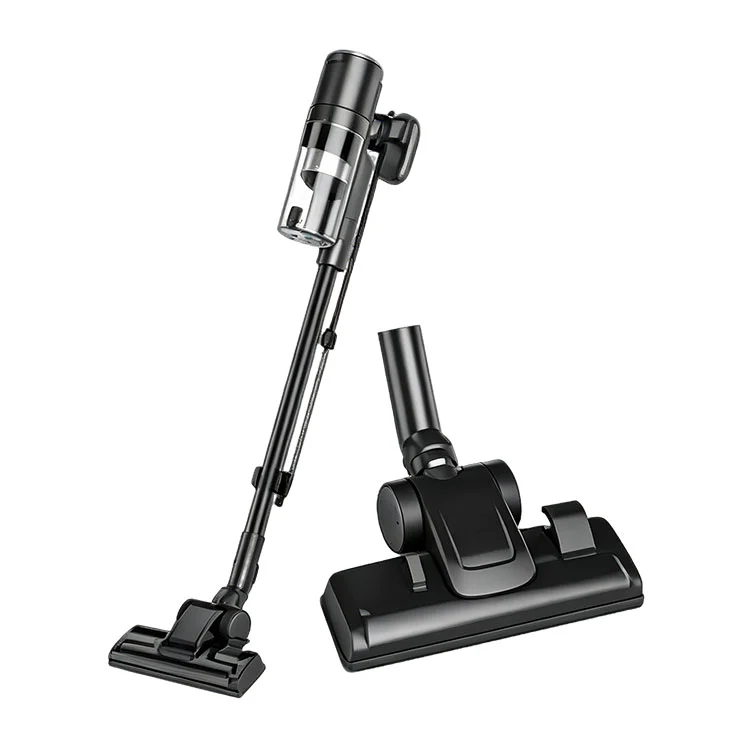
Pickup depends on the path from the floor opening to the filter, not on the motor figure alone. The High Suction Corded Upright Vacuum from TEH Electric Appliance combines a 270W high-voltage DC brushless motor, suction above 25 kPa, a powered roller head, a 1.2 L transparent PC cyclonic cup and a detachable 5–10 m cord. The air path, cup seating and filter access are arranged for OEM teams that need to inspect the assembled unit.
Dry grit and crumbs meet the powered roller before they reach the suction opening. During a normal pass, the roller moves material toward the inlet, the main motor draws air through the straight wand, and the cyclonic cup receives the collected debris. We use the High Suction Corded Upright Vacuum when a corded platform needs this complete route to remain visible during sample evaluation and daily cleaning.
Strong pickup in daily use does not come from the motor alone. The floor-head opening, wand joints, cup seating edge and filter condition all affect how the machine behaves on the floor. This model keeps those parts accessible, so a sample can be assembled, checked and maintained without treating the cleaner as a sealed black box.
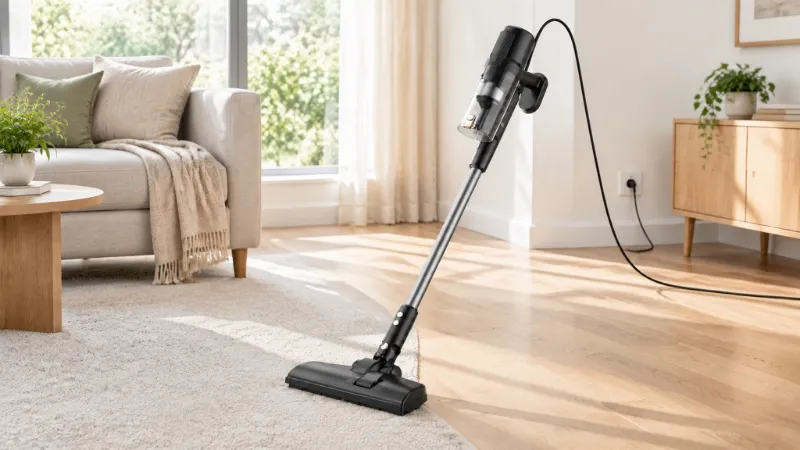
Corded mains power supports room-to-room cleaning without a charging pause. The detachable cord is selected between 5 m and 10 m, then matched with the plug, voltage and frequency required by the destination market. The operator can work through a planned route while the powered head and main suction motor run from the same market-specific electrical version.
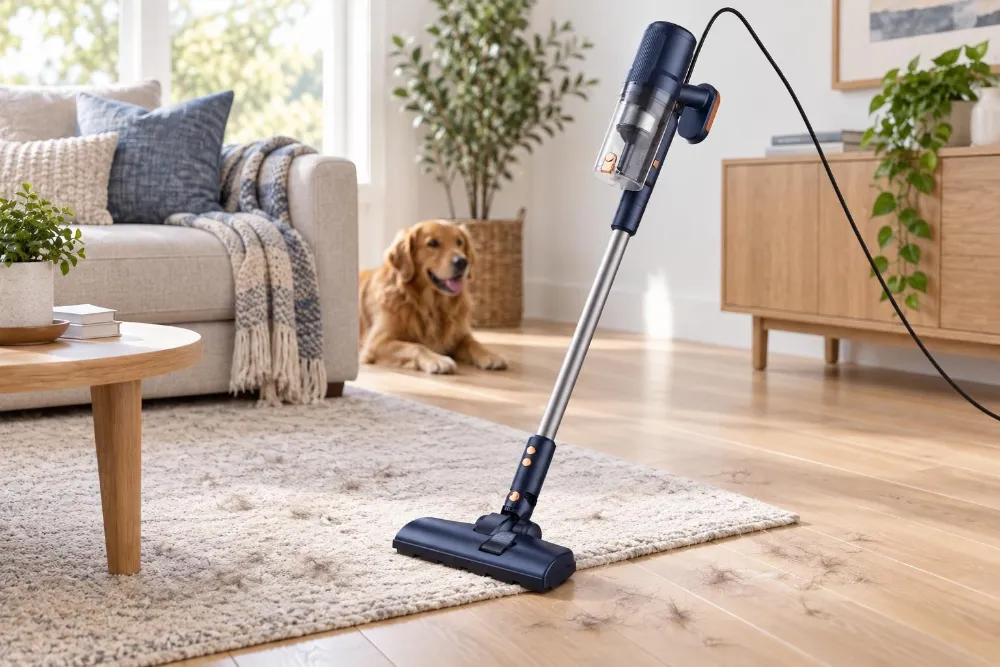
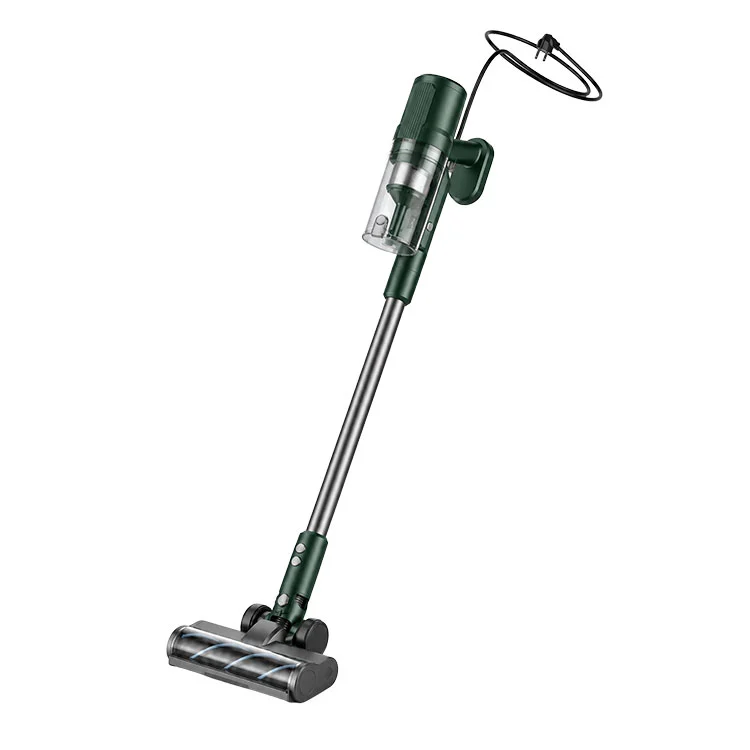
 Forest-green corded upright vacuum with powered roller floor head.
Pickup Starts With an Unbroken Air Path
From the Floor Opening to the Cyclonic Cup
Dry crumbs, grit and fine household dust first meet the powered roller near the front opening of the floor head. The roller moves material away from the surface and toward the suction opening, while the main motor draws air through the head and up the wand. These are separate actions: the roller provides mechanical contact, and the airflow transports what has been released.
A straight connection between the floor head, wand and main body limits unnecessary changes in direction. Every joint still needs to be fully locked because a small gap can alter the sound and reduce the airflow available at the floor. During assembly, the floor-head neck and both wand ends can be checked by hand before the product is connected to power.
Inside the transparent cup, larger particles remain visible instead of disappearing into a disposable bag. The cyclonic section handles the first separation stage, and the filter sits after that dust-collection area. Emptying the cup before debris reaches the intended fill level keeps the separation space open and makes the next cleaning route easier to observe.
Seating Surfaces Matter
The edge of the 1.2 L dust cup must sit evenly against the main body. Dust trapped on a sealing surface, a cup fitted at an angle or a filter that is not seated correctly can change the route of the air. A visual check around the clear cup is quick and can be performed each time the cup is emptied.
The transparent PC cup also helps distinguish a blocked path from an empty-floor condition. If pickup changes, the operator can first see whether the cup contains bulky material or long fibres. The machine can then be disconnected before the cup, filter, wand and roller are checked in sequence.
A useful sample inspection begins with a clean filter and an empty cup. After all connections are locked, the same dry material is placed on the same test surface. Keeping the starting condition consistent makes it easier to compare two samples or to evaluate a revised production sample against the first approved unit.
 Assembled suction-path check with the floor head on a sealed test panel.
Above 25 kPa in the Complete Machine
Suction and Floor Pickup Are Related but Not Identical
Suction for this version is specified above 25 kPa. That value describes pressure in the vacuum system; it does not replace a practical floor test. The opening under the head, roller contact, wand connection, cup seal and filter condition determine how the available suction reaches dry debris on a real surface.
For a useful comparison, the assembled machine should start with the same head, the same clean filter, an empty cup and the same electrical version. A pressure reading taken at one point should not be compared directly with a floor test carried out under different conditions. Recording the setup beside the result keeps the number connected to the actual sample.
A short controlled trail of dry crumbs and fine dust shows whether the front opening admits both light and heavier material. Forward passes, reverse passes and a slow turn can be observed separately. This reveals whether the head pushes debris ahead, leaves material behind the wheels or keeps the pickup path aligned during a change of direction.
Filters collect dust over time, so a new sample and a used sample may not sound or feel the same. The correct maintenance response is to inspect the cup and filter rather than assume that the motor has changed. A washable filter is cleaned separately, dried fully and refitted before the machine is operated again.
 Dry-particle pickup on a hard-floor entry area.
Brushless Motor for Repeated Room Cleaning
270W High-Voltage DC Drive
The main body uses a 270W high-voltage DC brushless motor to create airflow through the complete vacuum. The powered floor head has its own drive for the roller. This arrangement allows the roller to continue turning at the floor while the main motor handles the movement of air and collected dust through the wand.
Operating noise is below 75 dB for the assembled version. Sound comes from the motor, moving air and the powered head together. A sudden change in pitch is therefore checked at more than one point: the roller for wrapped hair, the cup and filter for restricted flow, and the wand joints for correct assembly.
The main motor has a running life of more than 500 operating hours. The cord connection, switches, floor-head drive and rotating parts also work through every cleaning cycle. Regular cup emptying, filter care and roller cleaning help keep the airflow path and moving parts in normal working condition.
Continuous mains operation is practical for apartments, offices, guest rooms and other routes where an available outlet is close to the work area. It removes battery charging from the schedule, but it makes cord routing important. The cable should stay behind the operator and away from the moving roller and front wheels.
 Continuous running check in an appliance laboratory.
Dust Cup and Filter Condition
Visible Collection Before Filter Service
The 1.2 L transparent cup shows the type and amount of debris collected during a route. Fine dust settles differently from fibres or larger crumbs, and the clear wall makes those changes easy to see. Emptying can be planned from the actual cup condition instead of from a fixed number of rooms.
The cup is removed only after power is disconnected. Debris is emptied through the intended opening, and the cyclone area and seating rim are checked before reassembly. The cup should lock without forcing it into position; resistance is a reason to look for trapped material rather than press harder.
H12 HEPA is the standard filter grade for this configuration, and H13 HEPA can be selected for a customized project. Each finished version uses the selected grade consistently across the installed filter, replacement filters, packing and instructions.
The filter is removable, cleanable, washable and replaceable. Washing is carried out away from the main body, and the filter must dry completely in a ventilated place before reinstallation. Operating the product with a damp filter is avoided because moisture does not belong in the motor airflow path.
 Dust-cup seating and seal inspection on the assembled vacuum.
Powered Roller on Everyday Dry Debris
Contact at the Floor
The roller has an independent motor and works directly at the floor head. On hard floors it meets fine dust, crumbs and short fibres near the suction opening. On short-pile carpet or entrance mats it agitates the surface while the main airflow carries loosened material into the cup.
The rear wheels and pivot keep the floor head in its normal forward direction while the wand changes angle. When checking a sample, the operator can move slowly along a straight line, pull back and turn around furniture legs. The head should remain flat enough for the opening and roller to work together.
Hair and thread can wrap around a rotating brush. After unplugging the machine, the roller window and both ends of the brush can be inspected and cleared as described in the product instructions. Roller maintenance and filter maintenance are separate jobs, and a change at one location should not be confused with a problem at the other.
Dry debris is the appropriate material for routine evaluation. Liquids, hot ash, sharp fragments and wet building residue are outside this product description. Keeping the test material representative of normal indoor cleaning protects the product and gives a result that relates to the intended application.
Electrical Versions for Destination Markets
Cord Length, Plug, Voltage and Frequency
The detachable power cord can be configured from 5 m to 10 m. A shorter cord may suit compact apartments and smaller cartons, while a longer cord can reduce outlet changes in hotel rooms, offices or open residential areas. The useful length depends on the actual route, not simply on selecting the longest option.
We configure the plug, voltage and frequency for the destination market. These choices are handled together because changing only the plug shape does not define a complete electrical version. The product label, cord, instructions and outer packing are prepared for the same agreed configuration.
A detachable cord is easier to separate for packing and replacement, but its connection to the machine must be fully engaged before operation. During a sample review, the cord can be gently moved near the connector while the machine is off, then checked during a normal route for unwanted pulling or intermittent contact.
Cord storage should follow the cable's natural bend. Tight folds near the plug or machine connector are avoided. The packing insert also leaves room around those ends so that transport pressure does not force the cable into an acute angle against the floor head or dust cup.
Sample Evaluation for Sourcing Projects
A Repeatable Check From Carton to Floor
A pre-production High Suction Corded Upright Vacuum sample can be evaluated in the order it will be received and used. Start with the carton and component protection, assemble the main body, wand, powered head and cord, then check that the cup and filter are fitted before connecting the selected market plug.
The first run can take place with an empty cup and clean dry filter. Listen to the main motor and floor-head roller separately, then move over a hard-floor panel containing a measured patch of ordinary dry debris. A second surface such as short-pile carpet can be added without changing the cup or filter between passes.
After the floor route, disconnect power and inspect the roller, cup, cyclone area and filter. Note where debris collected and whether any material remained at a joint. This sequence gives the sourcing team a practical view of assembly, pickup and maintenance within one sample session.
Cord reach is checked in a real room or a marked test area. The operator walks the intended route, turns at furniture and returns toward the outlet while keeping the cable behind the head. This makes it easier to choose between 5 m and 10 m than relying on a floor plan alone.
The sample carton can then be repacked to confirm that the powered head, clear cup and cord connector do not carry unwanted pressure. If branded packing is required, the printed sample follows the approved neutral layout, component list and selected electrical version.
A short written record can cover assembly fit, operating sound, dry pickup, head movement, cup emptying, filter removal, cord reach and repacking. These are observable points that help an importer, distributor or retail brand compare the sample with later production units.
Technical Specifications
| Attribute | Product specification |
| Brand | TEH Electric Appliance |
| Product type | Brushless corded upright vacuum with a powered roller floor head |
| Main motor | 270W high-voltage DC brushless motor |
| Suction | Above 25 kPa |
| Operating noise | Below 75 dB |
| Motor running life | Above 500 operating hours |
| Floor head | Powered roller with an independent drive motor |
| Dust cup | 1.2 L transparent PC cyclonic dust cup |
| Filter | H12 HEPA standard; H13 HEPA available as a project option |
| Filter service | Removable, cleanable, washable and replaceable |
| Power mode | Corded mains power |
| Power cord | Detachable; configurable from 5 m to 10 m |
| Regional electrical setup | Plug, voltage and frequency configured for the destination market |
| MOQ | 500 pieces |
| Sample | Available; sample charge confirmed separately |
| Packing | Kraft carton or neutral packing; branded packing can be discussed |
Applications
In apartments and houses, the product suits dry floor care across tile, stone, wood and short-pile rugs. The transparent cup is useful when entry areas collect a mixture of fine dust, crumbs and fibres, and the powered head can remain attached throughout the route.
In offices and studios, a 5-10 m cord can be selected around the outlet layout and furniture spacing. Cleaning can continue across hard-floor aisles and low-pile carpet tiles without a charging interval. The operator still manages the cable behind the machine during turns.
Hotel guest rooms and serviced apartments often combine a hard bathroom entrance, short-pile bedroom carpet and narrow spaces beside a bed. A sample route through those areas shows whether the selected cord length, head width and turning angle suit the property.
Small shops and property-maintenance teams may use the product for scheduled dry cleaning where mains power is available. The cup, filter and roller remain routine service points, and spare filters can be ordered with the matching product version.
OEM and ODM Configuration
We configure the High Suction Corded Upright Vacuum with the body color, logo position, cord length, plug, voltage, frequency, filter grade, accessory set, labels, carton and instruction language agreed for the project. Each option is applied to the same approved sample so the visual and electrical versions stay together.
H12 HEPA is standard, while H13 HEPA is available as a project option. Replacement filters can be included with the first order, and their grade and fit are matched to the finished product. The powered roller, 1.2 L cup and corded structure remain part of this product configuration.
The minimum order quantity is 500 pieces. Samples are available, with the sample charge confirmed separately according to the requested color, electrical setup, packing and accessories. A neutral sample may be used first, followed by a branded sample when the configuration is settled.
Kraft cartons or neutral packing are available for standard supply. A branded color box, outer-carton marks, labels and multilingual instructions can be discussed. The internal protection is arranged around the actual body, wand, powered head, cord and selected accessories.
Color decisions can use an approved physical sample or finish reference. The transparent cup remains clear enough to view collected debris, and color changes do not alter the direction of the floor head or the corded power arrangement. Logo placement avoids service openings, moving joints and areas held during use.
Product Functions
· Suction above 25 kPa through a corded upright vacuum system.
· 270W high-voltage DC brushless main motor.
· Powered roller floor head with an independent drive motor.
· 1.2 L transparent PC cyclonic dust cup for visible collection.
· H12 HEPA as standard, with H13 HEPA available for customization.
· Removable, cleanable, washable and replaceable filter.
· Detachable 5-10 m cord with market-specific plug, voltage and frequency.
· Operating noise below 75 dB and motor running life above 500 hours.
Frequently Asked Questions
What does suction above 25 kPa describe?
It describes the specified pressure level of this vacuum system. Floor pickup should still be checked with the assembled head, clean dry filter, empty cup and the intended surface.
Does the floor head have its own motor?
Yes. The roller has an independent drive motor, while the 270W high-voltage DC brushless motor in the main body creates the suction airflow.
Can the cord and electrical version be changed for our market?
Yes. The detachable cord can be configured from 5 m to 10 m, and the plug, voltage and frequency are prepared for the destination market.
What are the MOQ and sample terms?
The MOQ is 500 pieces. Samples are available, and the sample charge is confirmed separately for the requested version.
For samples, filter options, electrical versions, packing or an OEM quotation, use the Send Inquiry page or the Contact Us page to contact TEH Electric Appliance.
Send Inquiry
Contact Info
-
Address
No. 33 Fuxing Road, Nanzhuang Town, Chancheng District, Foshan City, Guangdong Province, China
-
Tel
-
Email
Share your email for Electrical equipment/pricing support—we’ll personally reply within a day.
Related Products
News Recommendations